AI mindset: how leaders can build a culture of builders
- Written by
 Alexandra Bigotte de Almeida
- Published
Key takeaways
- With AI, the distance between an idea and a first working version is short enough that people in every role now build it themselves instead of filing a request.
- A builder mindset isn't a job title: it's going from "someone should make this" to a working version you can show, then handing it to the right craft when it needs to last.
- In product work, the biggest shift is the handoff: designers and engineers now shape the same live prototype from day one, and each keeps their own responsibilities.
- Building fast only works with guardrails. AI plans and proposes, people review and decide, and every change still passes through someone who owns its quality.
- Companies that want this beyond a few enthusiasts need empowerment, protected time to learn, and visible examples from across the team, including leadership, not another tool license.
On a recent client project with a short build window, our designers stopped working in sequence. Instead of flows, then wireframes, then UI, then code, UX exploration started directly in a live prototype built with AI, with designers and engineers working on it at the same time. Nobody handed anything over. They built it together.
As Chief of Staff, I get an unusually wide view of how work happens across Pixelmatters, and that project wasn't an exception. It was a pattern. Designers are working in code, engineers are shaping product decisions earlier, and people in operations, marketing and sales are building the tools their own work needs. More and more of us are becoming builders, and I think that's one of the most important changes AI is bringing to how we work.
What is a builder mindset?
A builder mindset is the habit of turning an idea into a working version yourself, instead of describing it to someone else and waiting in their queue. It isn't a role or a skill level. It's a default: when something should exist, you try to make it exist, then bring in the people whose craft it is when it needs to last.
That last part matters. A builder isn't someone who does everyone's job. It's someone who can take the first step, test an idea and bring something tangible to the conversation, instead of waiting for someone else to start. But building doesn't mean skipping the thinking. If anything, it makes thinking even more important. You still need to question, imagine, make decisions and figure out what is worth building in the first place. AI just makes it easier to bring those ideas to life.
Why AI turned more of us into builders
AI shrank the gap between "I have an idea" and "here's a version you can click." When that gap was weeks of someone else's time, most ideas died in a backlog. When it's an afternoon, people just try.
The research shows the same shift outside our walls. Figma's 2026 AI report found that designers participating in development doubled to 41% (opens in a new tab) in a year, while developers doing design work rose from 44% to 60% (opens in a new tab). Anthropic's study of its own teams concluded that AI is enabling everyone to become more full-stack in their work (opens in a new tab), and that 27% of Claude-assisted work consists of tasks that wouldn't have been done otherwise (opens in a new tab).
That 27% is the part I find most interesting. The big change isn't only that existing work got faster. It's that people can now act on ideas they previously depended on someone else to execute. And that changes more than productivity. It changes how teams work, collaborate and make decisions.
What the builder mindset looks like across our teams
At Pixelmatters, being product-minded has always meant being builders: spotting problems, questioning how things work, and turning ideas into something useful. AI expands how we do that, across client projects and our own teams.
Designers and engineers work on the same prototype
The gap between design and engineering is where we see the biggest change. The traditional process runs as a relay: flows and wireframes first, UI on top, then code, with time and context lost at every pass. Designers often explore UX directly in high-fidelity UI inside live prototypes, with engineers building on the same thing. As they put it: "There's a point where we converge, which is the design itself. But each of us keeps our specific responsibilities."
It’s also why we have Design Engineers on the team, people who move between the design file and the codebase as one job rather than a handoff, and why Pixel AI™, our framework we use to design, build, and ship, includes prototyping in code.
Product managers make ideas easier to test and align on
Product Requirements Documents (PRDs) still matter. What AI changes is how quickly Product Managers can bring requirements to life, moving from written ideas and wireframes to a working prototype. Stakeholders can see and try the proposed experience, making feedback more concrete and reducing the time needed to align and approve how it should work. For non-technical stakeholders in particular, that makes product decisions easier to participate in.
People stay in the loop when agents build
Across our teams, working with AI agents means reviewing their plans, questioning their output and deciding what is ready to use. People stay in the loop, with each team responsible for the quality of what it builds.
In engineering, Rui Saraiva, our Principal Engineer, showed how this works at one of our Codematters sessions: AI plans before it builds, and people review that thinking, challenge it and approve the plan before implementation. Every change is checked against the plan, tested, and reviewed by an engineer before it merges.
Teams build the tools their own work needs
The same habit shows up around delivery. On another recent project, the team built an agentic research pipeline that analyzes user test transcripts and videos, brings them together with the team's notes and drafts the research report, with the team steering every step. When reviewing a live website meant writing "the button in the third section, on mobile" into a spreadsheet, we built our own tool to pin comments directly to any element of a live site. And the workflows one person works out on one project go into a shared repository of reusable AI skills, so they don't disappear when the project ends.
It isn't limited to the people who make software either. Across People, Finance, Marketing and Sales, we're seeing people build their own tools, automate workflows and find new ways to solve problems that previously depended on someone else's availability. From internal apps to reporting and event logistics, the builder mindset is spreading beyond traditionally technical teams.
And yes, some of it is just for fun
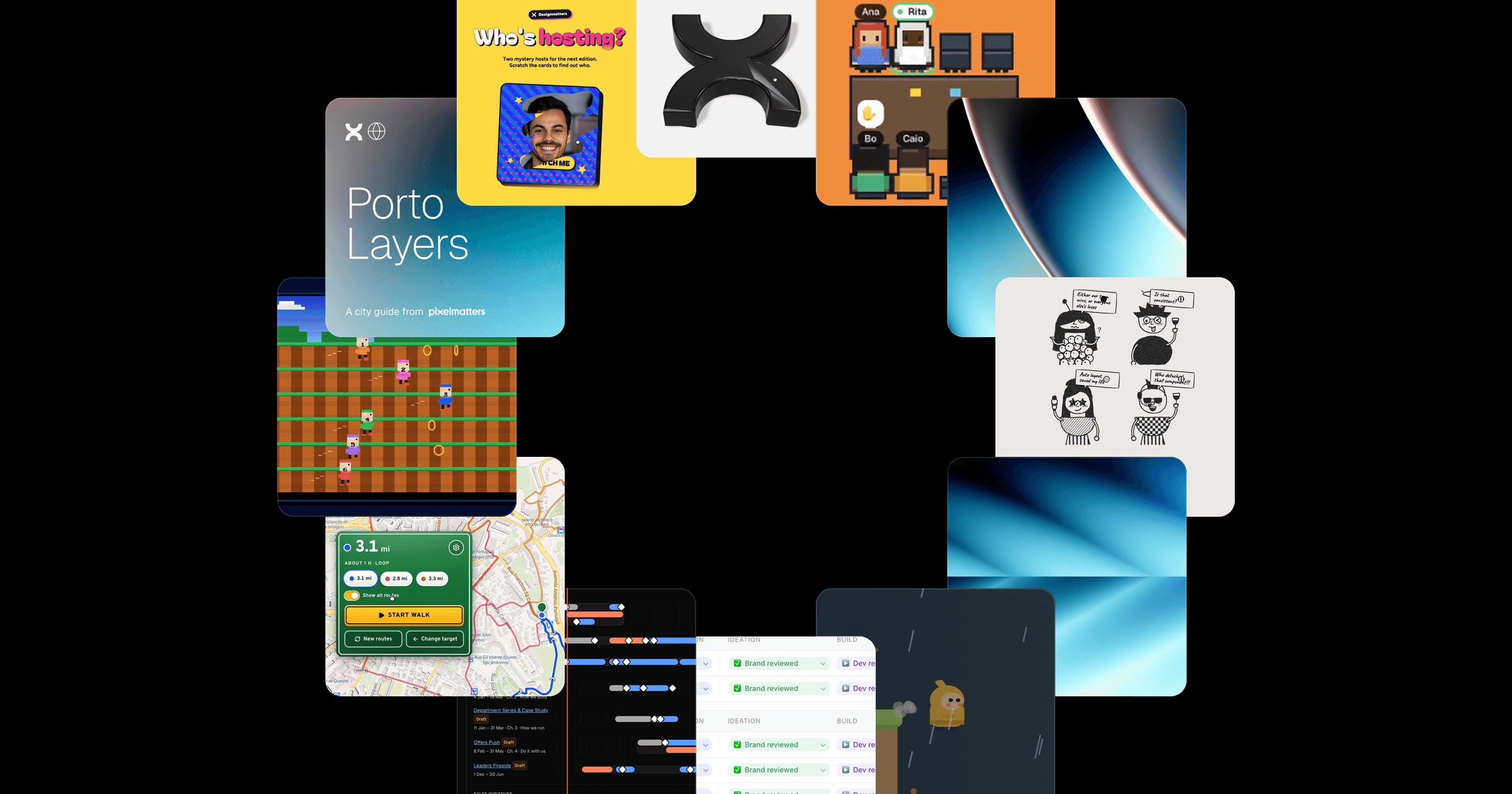
In a couple of weeks, the team also shipped a gummy version of our logo you can pull and slice, an app that plans walking loops back to where you started, a scratch card to reveal the hosts of an internal design session, and an arcade-style page that crowned the winners of our steps challenge, built by Fernanda Nicolini, who runs our office and events. We shared them in a roundup of what our team shipped with AI (opens in a new tab). Side quests are where people get to play with new tools, and some of them end up shaping how we work.
I think this is something we don't talk about enough. AI isn't taking the creative part out of building. If anything, it's giving more people the chance to be creative, experiment with ideas and enjoy making things. And sometimes, the things we build just for fun teach us as much as the serious ones.
None of these people changed jobs. What changed is the first move. Before, the first move was to ask someone. Now, more often, it's to try.
Where expertise and accountability matter most
Every team brings craft and judgment to what it builds. As an idea moves from an experiment to something people depend on, the requirements grow: security, accessibility, reliability and long-term maintenance need explicit attention, the right expertise and clear ownership.
For client work, those requirements are part of how we deliver. AI-assisted work goes through human review, testing, code review and release checks. Designers, engineers and Product Managers validate the decisions within their areas of responsibility, and people remain accountable for what ships. We also follow security and operational practices that support our ongoing work toward a SOC 2 Type II examination.
AI helps us explore more ideas and reach a working version faster. Our delivery process ensures that what reaches a client has been reviewed, tested and built to be maintained.
Why AI culture spreads by example, not by mandate
AI culture spreads when people see a colleague build something useful and think "I could do that." It rarely spreads because a policy says it should. That's why our internal craft sessions matter so much. Designmatters and Codematters are where a designer shows how a live prototype replaced a handoff, or an engineer shows how agents plan before they build, and the rest of the team takes it back to their own projects. Every Friday we also have an open session for the entire Pixelmatters team to join and learn what others are building with AI, showcasing the work itself, and asking questions.
It's also about creating a sense of pride in what people build, no matter how small. When people feel their work is valued and worth sharing, they're more likely to keep experimenting, and inspire others to do the same.
Leaders often miss how far this has already gone. In McKinsey's research, C-suite leaders estimated that 4% of employees use generative AI for at least 30% of their daily work (opens in a new tab), while the real figure was 13% (opens in a new tab). The opposite problem is just as common. BCG found that only 51% of frontline employees are regular AI users (opens in a new tab), a figure that has stagnated, and that only 36% feel adequately trained (opens in a new tab).
Both point to the same thing. Builders appear on their own, but they only multiply when the company makes room for them.
What leaders can do to build an AI mindset across the company
If you lead a company, the question isn't whether your people can build with AI. Some already are, probably more than you think. The question is whether your organization lets that habit spread past a few enthusiasts. From what I've seen, four things make the difference:
- Empowerment. Give people the autonomy and confidence to experiment beyond their usual responsibilities, and make it clear that a rough first version is a good outcome.
- Time and support. Learning to build takes hours nobody has spare. Protect them, and give people a starting point: a reusable example or a colleague they can turn to when they get stuck.
- Visible examples. Share what people build across teams, and recognize the people behind it. A colleague's tool is more convincing than any sales demo, and recognition gives people a reason to feel proud of what they contribute.
- A clear line. Be explicit about what can stay a quick experiment and what has to go to the people who own quality.
To see whether the habit is spreading, look beyond how many tools get built. Are people building again, are colleagues using what they make, and is it solving a problem that matters? Ask what still gets in the way, and use the answers to improve the support.
And none of this works if people are expected to experiment on top of an already full workload. Making room for change is a leadership responsibility. But accountability goes both ways: companies need to create the conditions, and people need to take ownership of what they do with them.
Microsoft describes where this is heading as the rise of the agent boss, "someone who builds, delegates to and manages agents to amplify their impact" (opens in a new tab). I'd add that the mindset comes before the agents. Our CEO, Bruno Teixeira, wrote about the same idea from the leadership side: adding AI isn't the same as becoming AI-native. If you want to know where your own culture stands today, an AI readiness assessment across product, process and culture is a good place to start.
This is also the work we do with other companies. Through AI-Native Enablement, we help product, design, engineering and operations teams change how they work with AI, using Pixel AI™, the AI-native framework we use on ourselves.
The best ideas no longer wait in a queue
The most valuable thing AI gives a team goes beyond speed. It shortens the distance between seeing a problem and showing how it could be solved.
When more people can build a first version, more ideas get tested, teams align around something tangible, and the right expertise comes in with better context.
For leaders, the opportunity is to create a culture where that initiative can grow: give people time, trust and support to experiment, recognize what they contribute, and keep accountability clear as ideas become things others depend on.
Someone on your team already sees an opportunity to make things better. As a leader, you help decide what happens next: does the idea join a queue, or does that person get the time, trust and support to build a first version and show what's possible?
Frequently asked questions
An AI mindset is the habit of reaching for AI to turn ideas into working results, rather than treating it as a search box or a writing aid. At work, it shows up as people trying things themselves, judging the output critically, and knowing when a quick version is enough and when to bring in additional expertise.
They overlap, but they're not the same. A citizen developer usually means a business user building apps on an approved low-code platform under IT governance. A builder is broader: anyone, in any role, who takes the initiative to turn an idea into something tangible, with AI expanding what they can build.
AI in the workplace blurs the edges between roles more than it replaces them. Designers prototype in code, engineers make design calls, and non-technical teams build their own tools. Core responsibilities stay: each team remains accountable for its work, bringing in the expertise needed to ensure quality, security and long-term maintenance.
No. Most of what non-technical builders make starts as a conversation with an AI assistant, not as code they write by hand. What they do need is clarity about what they want, the judgment to test whether it works, and a clear sense of when to involve others with the expertise the work needs.
You build an AI culture by making building visible and safe, not by mandating tools. Give people empowerment, practical support and protected time, share what colleagues make across teams, and draw a clear line between quick experiments and work that needs additional expertise and ongoing ownership. Leaders make this possible by protecting time, removing obstacles and recognizing what people build.
Written by

Alexandra Bigotte de Almeida
Chief of Staff